
Compare Face Symmetry
Put two photographs on the same measurement scale. Analyze each with the same landmark method, compare the regional readings and inspect the difference beside both previews. Matched camera conditions make the comparison easier to interpret.
Put two photographs on the same scale
JPG, PNG or WebP · up to 20 MB each
Photos are processed in this browser.
Use one visible face in each photo. The first analysis downloads the face model; wait for each photo’s status below. You can replace either photo without starting over.
Photo A your reference
Photo B your comparison
The JSON contains measurements and method details, without photo pixels or filenames. Clear both photos removes the current previews, results and download.
Build a consistent two-photo plan
Decide whether you want a matched repeat or a deliberate photography experiment. For a repeat, keep all six conditions below similar. For an experiment, change one condition, such as expression, and record it. Changing several at once makes the difference harder to interpret.
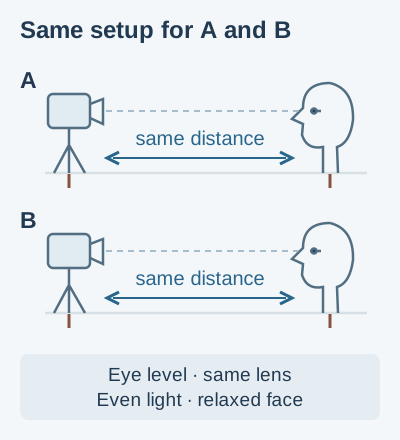
These checks record your plan; they do not certify photo quality. Keep the whole face visible, relax your mouth and look straight toward the lens. Avoid a close selfie paired with a distant portrait.
Ward and colleagues’ perspective model shows why camera distance can change apparent facial proportions. Matching eye spacing afterward does not undo that projection.
Choose the two photos ↑What does B minus A mean?
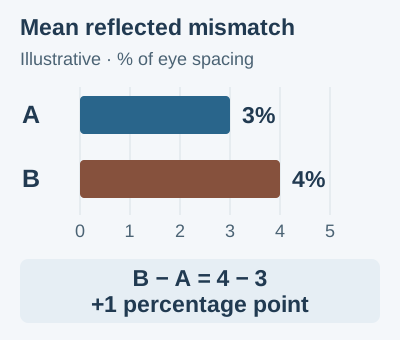
Each photo has an average reflected landmark mismatch, expressed as a percentage of its own eye spacing. Subtract A’s percentage from B’s percentage. A positive difference means B has greater mismatch under this method; a negative difference means B has less.
Keep percentage points separate from percent change
If A is 3% and B is 4%, B − A is +1 percentage point of eye spacing. The relative increase in this numerical mismatch is 1 ÷ 3 ≈ 33.3%, a different calculation. Neither number establishes a physical change.
The sign refers to the order of the photos, not a facial side. Swapping A and B reverses the sign. A zero difference means these computed averages match; it does not prove identical images.
| Result | What to look for | What it cannot establish |
|---|---|---|
| Overall A, B and B − A | The average across all 16 selected pairs in each photo. | A beauty rating, a clinical change or a universal symmetry percentage. |
| Six regional rows | Which region’s selected pairs contributed to the difference. | The condition of every structure within that region. |
| Individual pair details | Whether a regional difference is spread across pairs or concentrated in one. | Whether the detector placed every endpoint correctly. |
Read the photo warnings before the numbers. If one image is rejected, retake or replace it. An accepted image can still contain small pose, expression or landmark-estimation differences; acceptance is not an accuracy certificate.
What alignment changes - and what it leaves unresolved
The eye center on each side is the midpoint of its detected inner and outer corners. Their connecting line is leveled; their midpoint anchors the vertical reflection axis. The two previews then use the same displayed eye spacing. Turn the overlay off to inspect the original photo texture, or on to see the selected landmarks and reflected gaps.

One pair, then an average
For each pair, reflect one landmark across the aligned axis and measure the straight-line gap to its partner. Divide that gap by the photo’s eye-center spacing and multiply by 100. The overall mismatch is the arithmetic mean of those 16 percentages.
pair mismatch (%) = 100 × reflected gap / eye spacingcomparison = mean B − mean A
The MediaPipe detector estimates the landmarks. This website chooses the pairs, alignment and equation. Its estimated depth is not used to correct three-dimensional head turns. Leveling also absorbs the relative height difference between the two eye centers.
Uniformly resizing fixed landmarks preserves these ratios. Resizing and detecting the photo again can change the landmark estimates. For the exact landmark indices, implementation limits and method version, read how the measurement works.
A practical way to investigate a difference
- Check the setup. Did distance, expression or camera height change? Explain that difference before interpreting a number.
- Inspect the relevant pair. Look for a closed eye, raised brow, mouth movement, obscured contour or misplaced point.
- Take a fresh matched pair if needed. Repeated photographs can reveal capture variation. Two observations do not estimate a reliable noise level or statistical significance.
- Save the context. Download the JSON and keep your own note of camera, distance, lighting, expression and date if you plan to compare again.
Before you compare another pair
Can I compare a before and after photo?
You can compare the images, provided you match the capture conditions. Label A as the earlier photo and B as the later one in your own notes. The result cannot separate a physical change from pose, lighting, expression, image processing or detection differences, so it cannot demonstrate treatment success.
Can I compare two different people?
The tool will calculate measurements for two accepted photos, but the result is not a ranking of people. Different faces, viewpoints and photographic conditions introduce differences that eye-spacing normalization cannot remove. Use it to inspect images, not to decide who is more attractive or healthier.
Why do equal-sized previews still look different?
Only the eye line, eye-pair midpoint and eye spacing are matched. Expression, depth, perspective, head turn, lighting and the rest of the face can still differ. Equal framing does not mean equivalent input conditions.
Does flipping a selfie make it more symmetrical?
A pure reflection of fixed coordinates preserves this geometric mismatch. Running the detector again on flipped pixels can produce slightly different landmark estimates. For a visual orientation comparison, use the inverted filter; do not interpret a retest difference as a change to your face.
Where do my photos and the saved comparison go?
Analysis runs in this browser; photos and facial measurements are not uploaded. The JSON export is created locally when you choose to download it. A saved file remains on your device until you remove it. Clear both photos resets this page’s current comparison. See the privacy policy for the full processing details.
Sources and method review
- Google: MediaPipe Face Landmarker for Web - detector outputs and implementation context.
- Ward et al. (2018), Nasal Distortion in Short-Distance Photographs - primary mathematical research on camera distance and projected proportions; it does not validate this tool.
- Our published measurement method - selected pairs, reference axis, formula, checks and validation limits.
Published by Face Symmetry Checker. Research and implementation reviewed on . Illustrations are original explanatory schematics; numerical examples are synthetic. No independent clinical review or human accuracy study is claimed. Read our editorial policy.