
Do Selfies Distort Your Face?
The camera’s distance changes how facial depth appears in a flat image. A close selfie can enlarge nearer features relative to farther ones. See why moving back changes perspective, while cropping, zooming in place and flipping answer different questions.
Why a close camera changes proportions
Your face has depth. The nose, cheeks and ears sit at different distances from the camera. In a simple pinhole projection, image size is proportional to focal length divided by object distance. A nearby feature therefore occupies more of the image than an equally wide feature farther away.
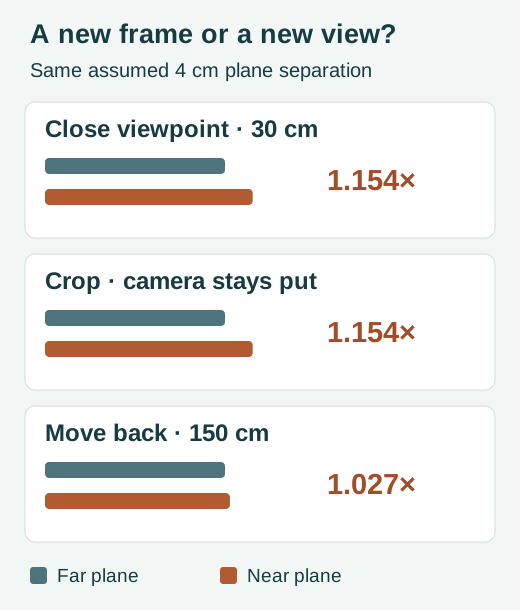
Moving back makes that depth difference smaller relative to the overall camera distance. The relationship changes even when you crop both pictures to show the same head size. The closer photograph and the farther photograph were made from different viewpoints.
This also applies to a rear camera used close to your face. “Front camera” and “back camera” are not distance measurements. Different lenses and processing can introduce additional differences, so changing cameras tests more than perspective alone.
Distance, zoom and a horizontal flip do different things
Camera distance
Moving the camera changes the viewpoint and the relative projected sizes of features at different depths. Keep the head facing forward when you test this.
Focal length or crop
From a fixed viewpoint, ideal focal-length changes scale the projection. A crop keeps a smaller region. Neither operation by itself removes the existing perspective relationship.
Mirror orientation
A horizontal flip swaps image-left and image-right. It keeps the same perspective, expression and lighting. It cannot shrink a nose relative to the cheeks.
Perspective is also different from radial lens distortion, such as barrel distortion, which can bend straight lines. The two can occur together, but a close viewpoint does not by itself establish barrel distortion. A lens correction may address a particular optical effect while leaving the close-camera perspective.
Verhoff and colleagues’ 2007 experiments separated camera distance from focal length. Their small study found a clear influence of distance on facial proportions without demonstrating an isolated focal-length effect. That supports keeping the viewpoint fixed when testing a lens claim.
Try a simple perspective model
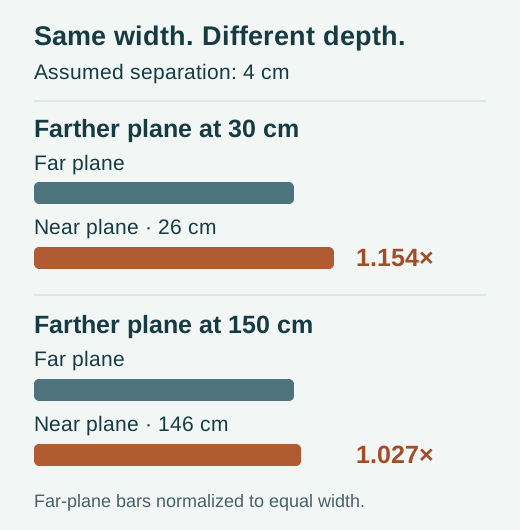
Imagine two equally wide, flat strips facing an ideal pinhole camera. One sits closer by the depth you choose. This model explains projection; the strips are not anatomical landmarks.
Chart rescales the farther strip to 100 each time. It shows relative widths, rather than a camera sensor or a face.
30 ÷ (30 − 4) = 1.1538. The nearer strip projects 15.38% wider than the equally wide farther strip.
See the units and why focal length cancels
For strip width W and camera distance Z, projected width = f × W ÷ Z. Both distances must use the same units. Here W = 20 mm, and distances in cm are multiplied by 10.
At f = 24 mm: farther strip = 1.6000 mm and nearer strip = 1.8462 mm on the ideal image plane.
Dividing the two projected widths cancels f and W: ratio = D ÷ (D − h). Changing focal length at the same viewpoint changes both projected sizes together. Cropping also rescales the frame; neither action recovers a farther viewpoint.
Assumptions: equal physical widths, parallel strips perpendicular to the camera axis, ideal projection, no optical distortion. There is no photo input, calibration or individual distortion estimate. The 4 cm starting depth is an invented example, separate from the Ward study.
The “30% bigger” headline needs a reference
Ward et al. (2018) modeled nasal breadth relative to cheekbone width using average facial dimensions. At 12 inches, their model estimated roughly 29–30% greater relative nasal breadth than an orthographic projection, the limiting view from infinitely far away.
That is a modeled relationship between defined widths. It does not mean your entire face, nose tip or lips become 30% larger. The authors reported essentially no perceived-size difference at five feet in their model; this does not make five feet a universal guarantee of an undistorted photograph.
Take a portrait you can compare sensibly
Start around 5 feet (1.5 meters) away if you have room. This is a practical starting point informed by the research, not a precision requirement. The goal is to reduce a very close viewpoint and make the next photograph under similar conditions.
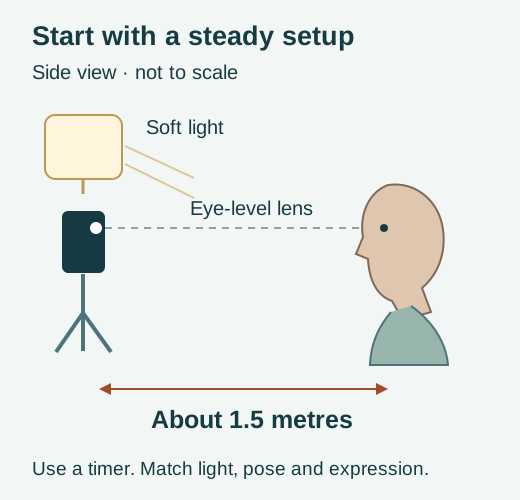
- Support the camera. Use a stable surface and a timer, or ask someone to hold it in one place. Put the lens at eye level.
- Keep your head straight. Look toward the lens, keep both sides visible and avoid a tilted or turned pose for measurement.
- Use soft, even light. A broad light near the camera direction is a useful starting point. Avoid one cheek disappearing into shadow.
- Keep your expression steady. Relax your mouth and eyes. A raised eyebrow or a smile changes visible feature positions.
- Frame after choosing distance. Use the camera’s framing controls or crop afterward. Keep enough detail for the features to remain clear.
- Keep the original file. Avoid reshaping filters. Record the camera, distance, mode, lighting and whether the saved image is mirrored.
For repeated measurements, consistency is more useful than searching for one supposedly perfect lens setting. Our guide to changing symmetry scores explains the other capture conditions that can affect a result.
Make a two-photo distance experiment
Take one photo at your usual selfie distance, then a second from farther away using the same camera and mode. Keep your head direction, camera height, light and expression as similar as possible. Crop both to a similar head size so framing does not distract from the comparison.
Write down what you changed
Changed: camera distance. Kept similar: camera, mode, head angle, light and expression. Look for: how the projected nose-to-cheek relationship and visible ears differ.
Compare the photographs in Compare Face Symmetry if both meet its frontal-photo checks. Its selected landmarks describe image geometry. A changed number cannot isolate perspective from expression or detection differences, and it does not establish a change in anatomy.
Then stop at a useful observation, such as “this farther setup is easier to repeat.” Taking many pictures until a preferred score appears does not establish accuracy.
Why the saved photo can feel unfamiliar
Sometimes the preview and saved file use different mirror orientations. Apple’s current iPhone guide, for example, documents a Mirror Front Camera setting. Check your camera’s saved-image setting rather than assuming all front-camera photos are mirrored.
Suchow et al. (2024) found differences in self-image familiarity and pleasantness under mirror reversal. This helps explain why a flip can feel different without changing facial proportions. It does not establish that a mirror is always more accurate or that every person prefers the same orientation.
Use the inverted filter to compare only orientation. For a separate experiment that repeats one half, see the perfectly symmetrical face guide.
Questions about selfie distortion
Does 2× zoom fix a close selfie?
Changing zoom while keeping the camera in place does not remove the close viewpoint. Move back first, then choose framing. Depending on the device and conditions, a zoom control may crop or switch cameras; the label alone does not guarantee a particular optical setup.
Is the rear camera more accurate than the front camera?
Neither label guarantees accurate proportions. Compare distance, viewpoint, lens behavior and processing. A rear-camera portrait taken very close can still have a close perspective. Use the same camera for a controlled repeat comparison.
Is a photo how other people really see me?
A photograph records one viewpoint, expression and moment. People see a moving, three-dimensional person from changing distances. Neither one photo nor a mirror is a complete representation of that experience.
Can the symmetry checker correct camera distance?
No. It levels the detected eye line and compares selected two-dimensional landmarks. It cannot reliably recover camera distance, hidden structures or a calibrated three-dimensional face from one uncalibrated photo. Read the measurement method before interpreting its index.
Can I calculate how distorted my own nose is?
The educational model compares assumed equal-width planes at known distances. Your face has more complex geometry, and a single photo does not supply all the required depths or camera calibration. Its output is not a correction percentage for your nose or symmetry score.
Sources and editorial notes
Published by Face Symmetry Checker. Research checked . Diagrams are original explanatory artwork; model examples are synthetic. This guide does not claim clinical review or validation of the website’s measurements.
- Ward et al. (2018), Nasal Distortion in Short-Distance Photographs. Primary geometric model; published online March 1, 2018.
- Verhoff et al. (2007), The influence of camera-to-object distance and focal length on the representation of faces. Primary experiments separating distance and focal length.
- Derakhshan et al. (2024), Quantifying Facial Distortion in Modern Digital Photography. Twelve-participant study; first online August 6, 2023.
- Suchow et al. (2024), A reflection on faces seen under mirror reversal. Self-image perception; online October 1, 2024.
- Apple, Take a selfie with your iPhone camera. Current saved-photo mirroring instructions.
See our editorial policy and report an unclear explanation.