
Perfectly Symmetrical Face
Copying either half of one portrait can create two different symmetrical faces. Explore how the effect repeats features, lighting and expression, then compare it with measuring the original photograph’s left-right differences.
Both versions can be symmetrical and still look different
Start with the original portrait. The image-left composite repeats the half you see on the picture’s left. The image-right composite repeats its other half. Neither reveals a hidden “true face.” These labels describe the displayed image, avoiding confusion about a person’s anatomical left and right.
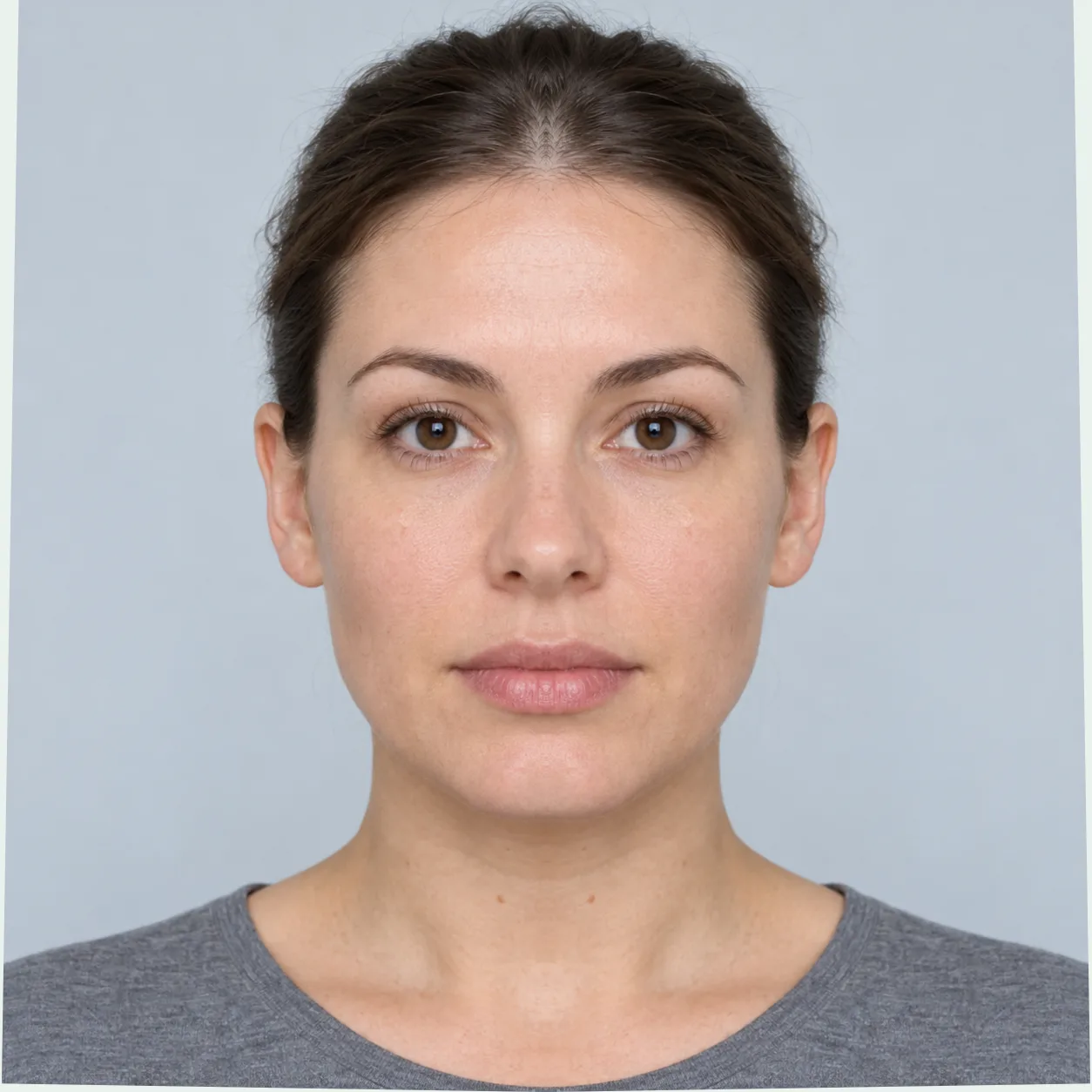
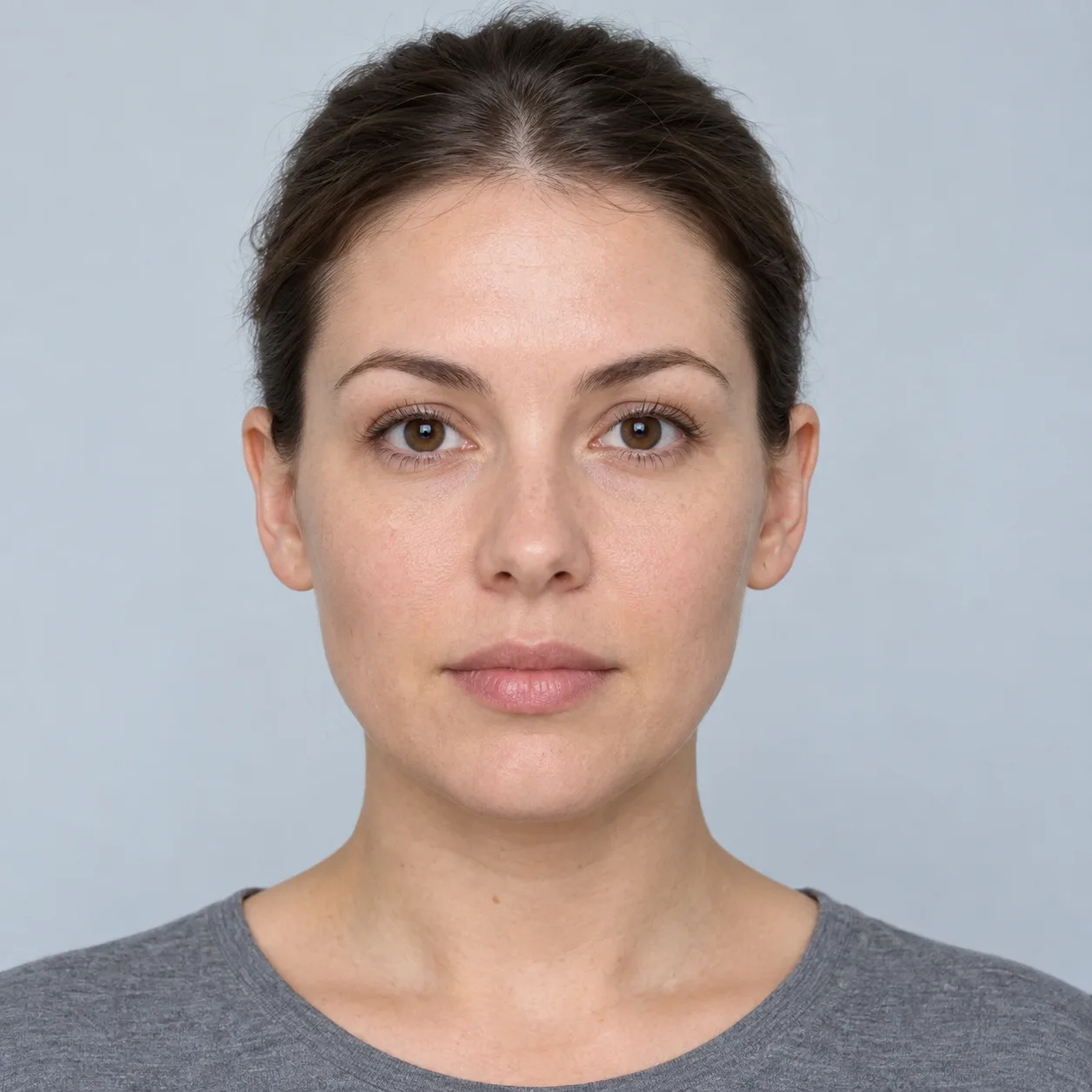
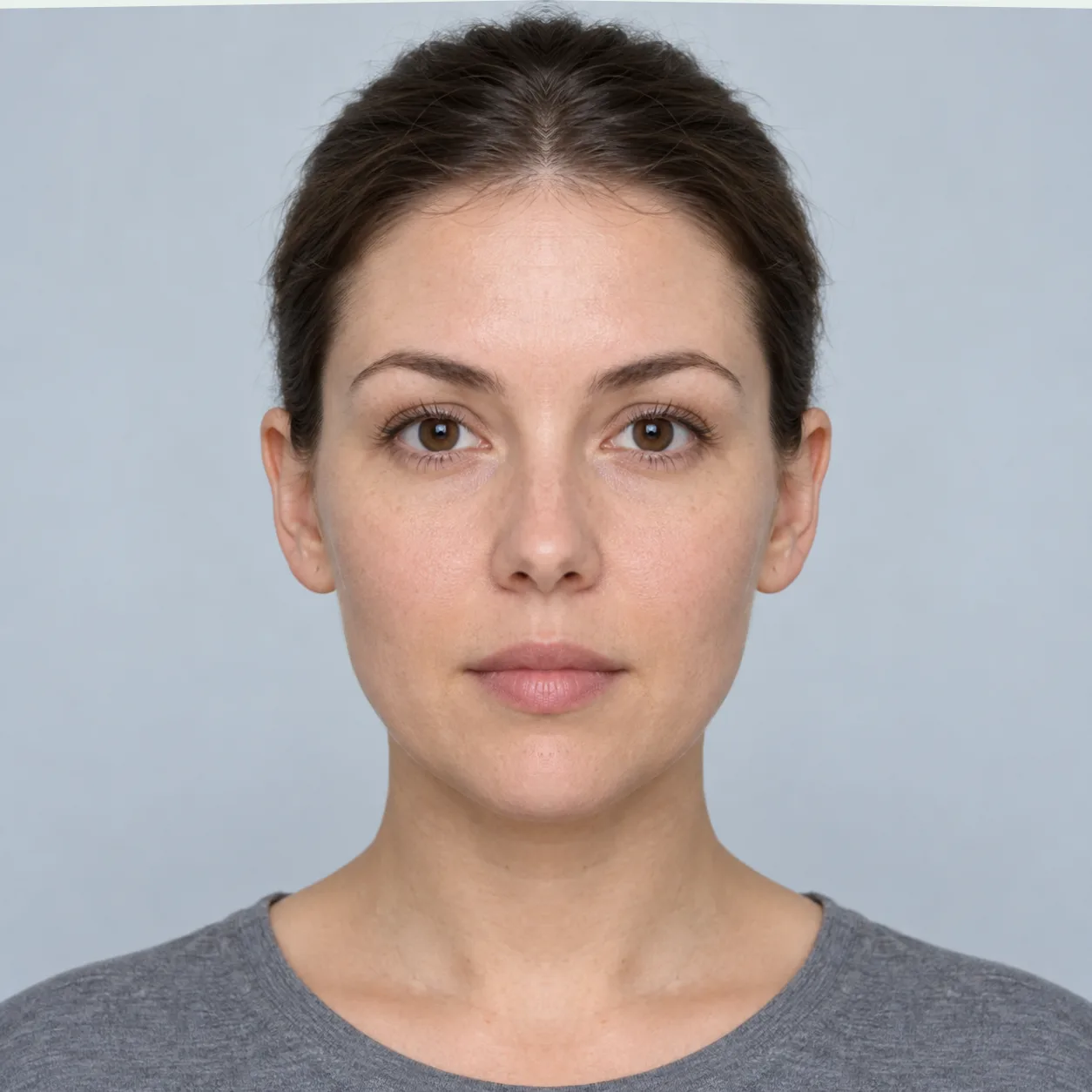
Fictional AI-generated sample portrait. The composites are actual outputs from this site’s detected-alignment mirror calculation. They illustrate the effect, with no claim about a real person’s anatomy or attractiveness.
Perfect for a reflection line, not a facial ideal
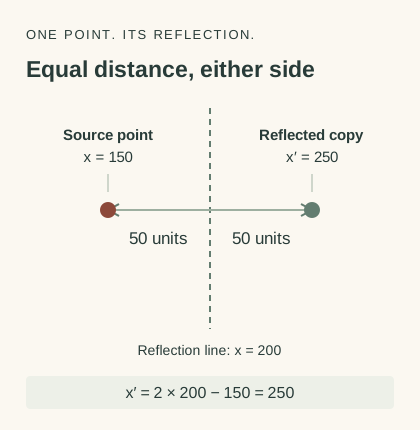
Reflection moves a point to the opposite side of a line, keeping its perpendicular distance and its position along the line. For a vertical line at horizontal coordinate c, the reflected position is x′ = 2c − x; the vertical coordinate stays the same.
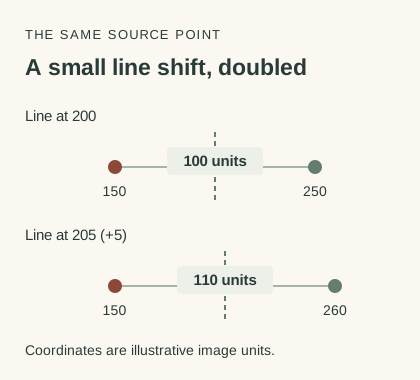
If the line is at 200 and a point is at 150, its reflection is at 250. Both sit 50 units from the line. This equality is built into the operation. It says nothing about whether a person’s face originally had matching sides.
Copying a half, flipping a whole image and measuring landmarks are different operations. A horizontal flip keeps both original halves and exchanges their positions. A composite discards one half and repeats the other. A landmark measurement compares selected corresponding points.
Build two versions from one pattern
Change a square in the pattern below, then choose which half to repeat. Notice which source details appear twice and which disappear from the output. The reflection boundary stays between the middle two columns. This demonstrates copying and reflection without using a personal photograph.
Make a pattern symmetrical
Change a square in this invented 8-column pattern. Then choose which half to repeat. The output copies that half, including its color differences. It does not calculate an improved pattern.
Original pattern
Each square is a button. Tab to a square, then press Enter or Space to cycle its color.
Mirrored output
The center boundary falls between columns 4 and 5. Columns are counted from the image’s left edge.
Image-left half repeated. All 24 corresponding pairs match by construction.
Output row 1, from left: pale, pale, teal, pale, pale, teal, pale, pale.
Read the pixel rule
Index the eight column centers from x = 0 to x = 7. Reflection maps x to 7 − x around the boundary x = 3.5. The pairs are 0↔7, 1↔6, 2↔5 and 3↔4.
For the left composite, output(x) = source(min(x, 7 − x)). For the right composite, use max instead of min. Every copied pair matches. This discrete pattern uses no interpolation; a rotated, resampled photo can have seams or small rendering differences.
This is a pixel-copy demonstration. No face score, beauty rating or personal photo is involved. The actual photo tools let you explore a portrait.
Why the cut line matters
For a point at x on the left of a vertical line c, its separation from its reflected copy is 2 × (c − x). Move the line 5 units to the right while keeping that source point fixed, and this separation increases by 10 units. It remains a symmetric pair.
That is why two mirror-line choices can both produce matching halves yet give different eye spacing or apparent nose width. A line selected on a photograph is an editing reference. It is not automatically a validated anatomical midline.
Why might a symmetrical face filter look unfamiliar?
A repeated half changes several things at once. Describing those changes is more useful than assuming everyone finds symmetry strange.
The seam changes relationships
An off-center cut can duplicate a different portion of the nose, mouth or chin. A slight head turn can make the two source halves project differently before either is copied. Leveling a photograph cannot reconstruct its missing depth.
Light becomes a pattern
A shadow, highlight, strand of hair or raised mouth corner is repeated. The result can look different even when the feature positions seem similar. Mirroring pixels includes their brightness and color.
You are seeing a new picture
The original contains both halves. Each composite contains only one, twice. Your reaction is a response to that edited picture, rather than proof that one side is good, bad or what other people see.
Does perfect symmetry make a face more attractive?
There is no reliable rule that your duplicated-half portrait will look better. Researchers study different image manipulations and different kinds of judgments. Their results cannot be turned into a personal beauty target.
Lee and colleagues (2021) compared forced choices with individual attractiveness ratings across three studies. Symmetry preferences differed with the task and the manipulation. Choosing between two edited versions is not equivalent to rating a portrait on its own.
Zheng and colleagues (2021) manipulated symmetry and configuration in 16 Chinese male faces. Their findings linked attractiveness judgments to the perceived typicality of those edited faces. This restricted experiment does not establish a universal ideal for all people.
Taylor and colleagues (2014) measured three-dimensional facial surfaces in 100 volunteers and documented small left-right differences. Their calibrated 3D measurements are a different method from this website’s selected 2D photo landmarks; their numerical ranges should not be applied to our index.
Keep the practical distinction: symmetry describes a relationship between features or pixels. Attractiveness is a judgment. This page creates no objective winner and supplies no health, personality or treatment inference from a mirrored image.
Before interpreting the effect
Can a real person have a 100% symmetrical face?
Exact matching of a whole face depends on what is measured, at what resolution and around which reference. Small differences are documented in natural faces. An online number rounded to 100 does not prove exact anatomical symmetry. A duplicated-half image achieves matching halves through construction.
Is a mirrored composite how other people see me?
Other people see both of your actual facial halves as you move and speak. A left-left or right-right composite repeats one half. Even a whole-photo horizontal flip only changes that photograph’s orientation; it does not reproduce a moving, three-dimensional view.
Why do my two symmetrical versions have different widths?
Their source halves can contain different projected contours, spacing and shadows. The cut line also determines how far a source feature sits from its reflection. Review the original and line placement before attributing an edited width to your anatomy.
Will a perfectly mirrored image get a perfect checker score?
The construction and the measurement use different references. The checker detects landmarks again and applies its own eye-based axis and selected pairs. Estimated points, interpolation and rounding can affect the output. A score cannot validate the editing effect or prove clinical accuracy.
Can I use this to decide which side needs changing?
A composite cannot identify a treatment need or predict a procedure. If you are choosing a portrait, you can compare your own preferences in the good side finder. A persistent physical or functional concern needs an assessment that a photo effect cannot provide.
Sources and editorial review
- Lee et al. (September 2021): Preference for Facial Symmetry Depends on Study Design - primary research on judgments and experimental tasks.
- Zheng et al. (June 2021): Normality mediates the effect of symmetry on facial attractiveness - primary research using a restricted set of manipulated portraits.
- Taylor et al. (January 2014): Quantitative facial asymmetry - 3D surface measurements in volunteers.
- Our measurement method - the separate reference, selected landmarks and validation limits of this site’s checker.
Published by Face Symmetry Checker. Content and sources reviewed . Coordinate drawings are original teaching examples; the gallery uses a labeled fictional portrait. No independent clinical review is claimed. Read our editorial policy.