
Facial Asymmetry
Unevenness can involve facial shape, position or movement, and a photograph may emphasize it. Learn how to describe what you have noticed and what a photo cannot explain. Sudden facial drooping or weakness needs emergency assessment.
An uneven feature is an observation, not a diagnosis
One eyebrow may sit higher, one cheek may look fuller, or the chin may sit away from a chosen centerline. A smile adds another question: how each side moves. These observations can overlap, but they are not interchangeable.
Penn Medicine describes some degree of asymmetry as normal for most people. It also identifies circumstances involving injury, development, dental structures, nerves or muscles. Appearance alone cannot tell you which explanation applies.
“I noticed it yesterday” and “it changed yesterday” mean different things. Write down what made you notice it: a passport photo, a flipped selfie, discomfort, or an actual change in movement. That distinction helps you explain the concern without deciding its cause yourself.
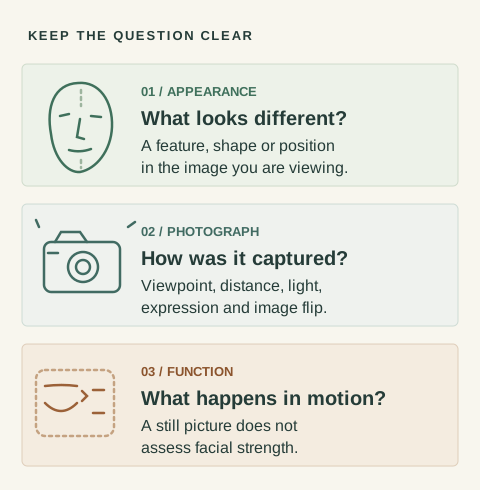
What can a photograph establish?
Appearance in this image
A photograph records a viewpoint, expression and moment. Lighting may make one contour more prominent; a small head turn changes the projection of both sides. A marked difference in one picture is a reason to examine the picture’s conditions, not proof of a skeletal change.
Change over time
Older photos can help explain when something was visible. Different angles, ages and expressions limit the comparison. Similarity to a relative, or a feature visible in an old picture, does not establish that a current symptom is harmless.
How the face works
A still image does not assess facial strength, sensation, eye protection or your bite. If the concern involves movement, chewing, pain or progressive change, describe that directly to a healthcare professional. An online percentage cannot answer those questions.
No universal “normal percentage.” A reference line, selected points and denominator define a measurement. Changing them changes the result. A threshold from one research method cannot be transferred to an unrelated selfie score.
Make one useful photo record
If there are no new symptoms and your question concerns how a photograph looks, choose a simple, repeatable setup. Do not take photos or complete this exercise when urgent care is needed.

- Center the camera at eye level. Look straight ahead with a relaxed expression. Avoid an overhead view or deliberately posing to hide a feature.
- Use even light and a fixed position. Record the approximate camera distance and keep it similar if comparing existing photos. A timer or another person can help.
- Keep an unfiltered original. Note whether the saved image is mirrored. A horizontal flip reverses the picture; it does not remove perspective or reconstruct a three-dimensional face.
- Write one concrete observation, then stop. “The left mouth corner appears higher in this saved image” is more useful than “my whole face is wrong.” You do not need a large archive of repeated checks.
Greater camera distance reduces differences in perspective magnification, but five feet is not a diagnostic boundary. Ward and colleagues (2018) modeled nasal breadth relative to cheekbone breadth at selected distances. Their result does not prove that every difference in a close photo is distortion, or that a more distant photo rules out a health issue. Explore the camera-distance explanation for the geometry.
Photo tools describe selected geometry
The main checker compares 16 landmark pairs using an eye-based reference and normalizes their reflected mismatch by eye-corner-center spacing. The result describes those selected points in a two-dimensional image. Adding more decimal places or more measurements would not establish a diagnosis.
Read the formulas and their limits before interpreting a result. The facial symmetry guide explains measurement; the causes guide explains why a photo cannot identify an individual cause.
Describe the change and its effect on daily life
For a longstanding, unchanged appearance concern without symptoms, you can discuss it at a routine medical or dental appointment. Arrange assessment sooner if the difference is progressing or accompanied by pain, swelling, altered chewing or a changing bite; seek urgent medical advice for new weakness. The emergency guidance above applies to sudden drooping, numbness or weakness.
A dentist can evaluate tooth and bite concerns; a medical clinician can assess unexplained changes, movement or sensation and arrange appropriate referral. You do not have to identify the specialist or arrive with a diagnosis. A useful starting question is: “What needs examining to understand this change?”
Jaw sounds need context
NIDCR distinguishes common painless clicking, which does not need treatment, from problems such as pain, locking or a change in how the teeth fit. Those symptoms deserve discussion with a doctor or dentist. A photo cannot diagnose a temporomandibular disorder (TMD).
Swelling with tooth or gum pain needs dental attention
A dental infection is one possible explanation for a swollen cheek or jaw. Seek an urgent dental appointment if you suspect an abscess. Seek emergency care if swelling comes with difficulty breathing, speaking or swallowing, a swollen or painful eye, or new eyesight problems. Substantial mouth swelling or difficulty opening your mouth also needs emergency care. See NHS dental abscess guidance; a symmetry photo cannot identify or rule out an infection.
An examination may include history, movement, facial tissues, teeth and jaw relationships; imaging is selected when clinically appropriate. Penn Medicine’s assessment overview describes clinical examination and possible imaging. This is why a selfie comparison cannot replace that process or determine whether treatment is needed.
A short observation worksheet
Use this as a paper checklist or a prompt for your own notes. To print this worksheet, choose Print or Save as PDF in your browser. The print layout shows this sheet. Checkboxes only mark preparation tasks; there is no submission.
Do not delay urgent care to finish notes. Sudden facial drooping, numbness or weakness needs an emergency call, even if symptoms stop.
What I noticed / when:
Effect on everyday activities:
My question for the appointment:
Common questions about an uneven face
How much facial asymmetry is normal?
Some degree of unevenness is common, but there is no number from this checker that separates ordinary variation from a condition needing assessment. The method, photo and selected landmarks all affect the value. For a concern about your own face, the timing, symptoms and effect on daily activities are more useful to describe than whether a score crossed an arbitrary cutoff.
Why does my face look more asymmetrical in a back-camera photo?
The camera position, distance, light, expression and whether the image is flipped can differ from your usual mirror view. “Back camera” does not define a standard viewpoint. Keep those variables separate; neither camera automatically shows a complete, objective version of how you look in person. See what an inverted filter actually changes.
Does a matching family feature mean there is nothing to check?
No. Family resemblance may be useful context, but it cannot establish why a particular feature differs or explain a new symptom. Describe new or progressive changes separately from longstanding traits. A similar feature in a relative is not a reason to delay assessment of new weakness or pain.
Can I fix asymmetry by chewing on the other side or changing sleep position?
A photo cannot identify a habit as the cause or prescribe a correction. Do not force one-sided chewing or buy a jaw-training routine on the strength of a selfie score. NIDCR advises caution with treatments that permanently change the bite or joints. Start with the symptom or function you want help with; read how to approach improvement claims.
Does more asymmetry mean less attractiveness?
A geometric measurement is not a beauty ranking. Research tasks and image samples affect the findings, and our score has no validated attractiveness cutoff. The attractiveness evidence guide separates experimental preferences from claims about an individual.
What if checking photographs is taking over my day?
You can stop measuring without first finding a reassuring number. If appearance worries or repeated checking affect your work, relationships or daily life, speak with a healthcare or mental-health professional. NHS information about body dysmorphic disorder explains when to seek help. This page cannot determine whether you have that condition.
Sources and editorial checks
- CDC: Signs and Symptoms of Stroke - emergency signs and immediate action.
- NHS: Symptoms of a stroke - help even when symptoms stop; do not drive yourself.
- NHS: Bell’s palsy - urgent assessment, early treatment and eye protection.
- Penn Medicine: Facial asymmetry - definition, clinical context and examination.
- NIDCR: Temporomandibular Disorders - painless joint sounds, symptoms and treatment caution.
- NHS: Dental abscess - urgent dental treatment and emergency swelling symptoms.
- Ward et al. (2018): Nasal Distortion in Short-Distance Photographs - a projection model of specified facial breadths, not a health test.
- NHS: Body dysmorphic disorder - appearance distress and getting support.
Published by Face Symmetry Checker. Content and linked sources checked . Original diagrams explain concepts; they contain no patient images, measured clinical results or fabricated testimonials. No independent clinician review is claimed. Editorial policy.