
Is Facial Symmetry Attractive?
Does a more symmetrical face always look more attractive? Research depends on which faces were studied, whether images were edited and what else was measured. This guide separates those findings from the claims a photo score cannot support.
What does “symmetrical” actually describe?
Symmetry asks how closely corresponding features match across a reference line. Proportion compares distances, such as face height divided by width. Attractiveness is a judgment made by a viewer. Those three questions need different evidence.
Two outlines can both be perfectly symmetrical while having different widths, eye spacing or mouth shapes. Matching halves alone cannot select a preferred outline. Likewise, a face can have one proportion close to the golden ratio and still have unequal sides.
In research, averageness means closeness to the average shape of a specified sample. It does not mean an ordinary personality, a fixed global face template or the middle of a beauty scale. A sample average and a reflection line answer different geometric questions.
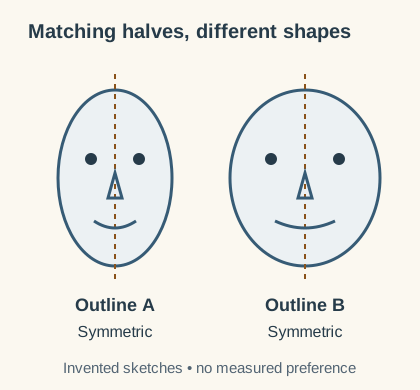
Why the research does not give one universal answer
Ask whether a study changed the same face, measured differences between people, or asked viewers to choose between two images. Keep that question beside the headline.
Evidence that increasing symmetry can change ratings
Rhodes and colleagues reported that increasing symmetry made faces more attractive in their experiments, using manipulations designed to avoid the distortions of simply duplicating a half. This supports a symmetry effect under those experimental conditions. It does not supply a personal score threshold or show that a mirrored-half filter improves every portrait.
Choosing between a pair differs from rating one image
Anthony J. Lee and colleagues compared the tasks in studies with 340 and 256 participants. They found a symmetry preference in paired choices, but not an association in individual ratings. A third study with 159 participants found larger rating differences when asymmetry was exaggerated than when an original was made symmetrical.
The studies used limited face sets and opposite-sex judgments. Their results show why task and manipulation deserve attention; they do not establish that symmetry never matters.
A larger, broader sample challenged a simple rule
Kleisner and colleagues analyzed 1,550 portraits from ten populations, using 72 facial landmarks and models that considered several shape properties together. Symmetry did not explain attractiveness in their analysis; distinctiveness, the converse of averageness, did. Ten sampled populations provide broader evidence than one sample, while still leaving people and contexts unrepresented.
A separate study found a similar pattern
Pengting Lee and colleagues studied 100 unedited portraits of white young adults with neutral expressions, rated by 400 participants. When shape properties were analyzed together, averageness predicted attractiveness; symmetry did not independently do so. The restricted image sample limits generalization. A nonsignificant result is not proof that every possible symmetry effect is zero.
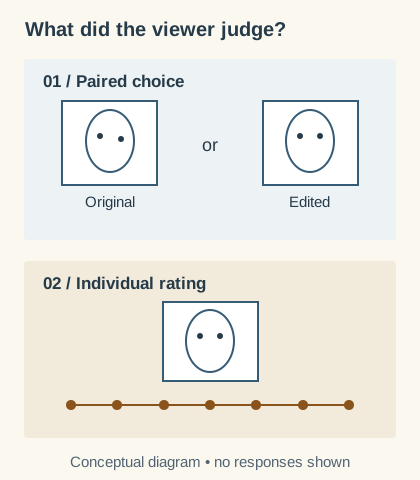
A comparison can direct your attention
Place two nearly identical pictures together and their differences become the focus of the task. View one picture by itself and the viewer has no matching reference beside it. This is a practical reason to inspect how a “symmetry is attractive” claim was tested.
Now consider a left-left or right-right composite. It repeats one half’s shape, expression, light and texture. A reaction to that edited image cannot isolate the effect of symmetry. A strange-looking composite does not prove that symmetry is unattractive; a preferred composite does not prove it is a physical ideal.
The useful question is narrower: What changed in this image, and what did the viewer actually judge?
Before trusting a facial beauty claim
Open each question and look for the corresponding detail in a study, app or social post. Missing information makes the claim harder to assess.
1. What was measured?
Look for named landmarks, a reference line and the formula. “AI-powered” does not define a measurement. If the output combines symmetry, proportions and skin appearance, ask how each component contributes and whether anyone validated that combined output.
2. What did people judge?
A forced choice between two versions, a rating of one portrait and a real social interaction are different outcomes. A claim about one should not silently become a claim about all three. Check whether the pictures were altered and whether viewers rated the same people.
3. Who was included?
Read the numbers of faces and raters, image conditions and sample characteristics. Hundreds of raters looking at a small set of identities still leave uncertainty about other faces. A group result cannot tell you what every viewer will prefer.
4. Does the conclusion outrun the result?
An association is not a treatment recommendation. A preference is not proof of health, genetic quality or character. A percentage requires a defined denominator: ask whether it represents geometric mismatch, agreement with a chosen template, or something independently validated.
What your result on this site means
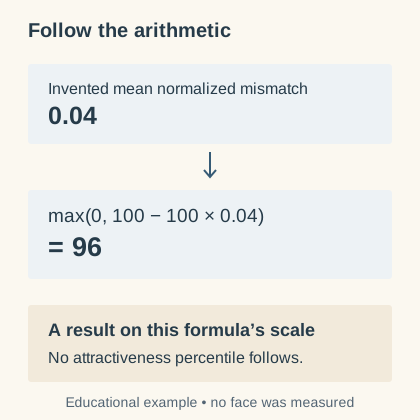
Our main checker reflects one landmark of each of 16 selected pairs across an eye-based axis. It measures each reflected mismatch, divides by the distance between the eye-corner centers, and averages those normalized values. Its index is max(0, 100 − 100 × mean mismatch).
For an invented mean mismatch of 0.04, the index is 96. That means 96 on this formula’s scale. It does not mean 96% attractive, more attractive than 96% of people, or that 4% of your face needs changing.
A different pose, reference or estimated landmark can change the result. Read the full measurement method and why a symmetry score changes before comparing numbers. The published studies above use different methods; their findings do not calibrate our index.
Make the decision you actually need
A profile-picture choice does not require a theory of universal beauty. Try a bounded comparison:
- Choose two portraits with a similar camera position and lighting. Keep the originals available.
- View each alone first. Write a concrete observation, such as “the eyes are in focus” or “the expression suits this profile.”
- View them together. Check whether the comparison changes what you notice.
- Use the good side finder to record your own preference. There is no automatically correct side.
This is a decision exercise, not an experiment estimating your attractiveness. If the real question is why one selfie looks different, start with camera distance and perspective. Repeated measurement cannot supply a beauty cutoff that has never been validated.
Symmetry, preference and appearance
Can an asymmetrical face be attractive?
Yes. Attractiveness is not defined by perfect matching halves. The evidence above does not establish exact symmetry as a requirement, and there is no validated threshold on this site that separates attractive from unattractive people.
Does everyone prefer the same face?
No. Germine and colleagues (2015) found substantial individual variation in face preferences in a twin study, with most reliable variation attributed to environments unique to individuals. This concerns differences in preference within that sample; it does not make every aesthetic judgment arbitrary or identify your personal preferences.
Does a higher symmetry score mean better health or genes?
This photo index has not been validated to measure health or genetic quality. Explanations proposed in attraction research cannot turn a selected-point photo calculation into an assessment of an individual’s biology. Do not infer character or a treatment need from the number.
Is there a good symmetry percentage for attractiveness?
There is no validated attractiveness cutoff for our index. Tools use different landmarks, references and scales. See how to interpret a symmetry score for the geometric meaning of a result.
Sources and editorial review
- Rhodes et al. (1998), Facial symmetry and the perception of beauty - experimental manipulation.
- Anthony J. Lee et al. (2021), Preference for Facial Symmetry Depends on Study Design - comparison of tasks and manipulations.
- Kleisner et al. (2024), Distinctiveness and femininity, rather than symmetry and masculinity, affect facial attractiveness across the world - measured natural variation.
- Pengting Lee et al. (2025), Further evidence that averageness and femininity, rather than symmetry and masculinity, predict facial attractiveness judgments - joint analysis of shape properties.
- Germine et al. (2015), Individual aesthetic preferences for faces are shaped mostly by environments, not genes - variation in preferences.
Published by Face Symmetry Checker. Content and sources reviewed . Diagrams are original educational illustrations; no research results or real faces are fabricated. No independent clinical review is claimed. Read our editorial policy.