
How to Make Your Face More Symmetrical
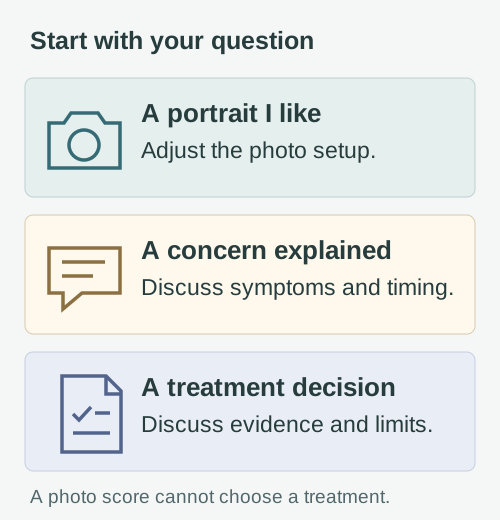
First decide what you want to change: the photograph, an ongoing functional concern or a feature you are considering treating. Review the evidence and limits of common approaches before choosing a routine or procedure. A photo score cannot prescribe a correction.
What would you like to be different?
“More symmetrical” can mean a photograph you like, easier chewing, a clearer explanation for a changing feature, or a particular cosmetic result. Write the goal in one sentence. “I want my passport photo to look less tilted” leads to a different next step from “my bite feels different when I eat.”
Penn Medicine explains that some unevenness is common and that assessment can involve facial tissues, teeth and bones. A fuller cheek, an uneven smile and a shifted bite are observations; they do not identify the same underlying problem. The causes guide separates those possibilities.
For a longstanding appearance preference without symptoms, taking no action is also an option. If a feature is changing, movement is different, or there is pain or swelling, arrange appropriate medical or dental assessment. Do not use an attractive photograph as reassurance about a new symptom.
Improve the portrait setup
For an ordinary photo preference, make one comparison with the camera centered at eye level, a relaxed expression and even light. Keep an original without a beauty filter. If a close selfie makes features look unfamiliar, move the camera farther away and crop for framing. Distance changes perspective; cropping alone does not.
- Choose one purpose. A flattering portrait and a repeatable record are different tasks. For a record, keep distance, camera height, head position, expression and lighting similar.
- Change one photo condition. For example, compare side light with more even light while keeping position fixed. Decide which image serves your purpose without treating it as a bone measurement.
- Keep orientation clear. Note whether an image is mirrored. A flip reverses left and right; it does not reconstruct what another person sees from every viewpoint.
- Stop when the question is answered. You can choose a photo without chasing a particular score or taking dozens of nearly identical pictures.
The selfie-distance guide explains the projection geometry. For a portrait preference, compare your own selected angles; the tool does not declare a universally better side.
Do mewing, face yoga or chewing exercises work?
Tongue posture is not a proven symmetry treatment
The American Association of Orthodontists says research does not support mewing’s jawline-reshaping claims. It warns that forced, uneven tongue pressure may affect teeth, bite or speech. This is not a substitute for an orthodontic assessment or a prescribed therapy for a diagnosed functional problem.
Aging-appearance findings do not establish symmetry correction
Alam and colleagues’ 2018 pilot enrolled 27 women aged 40–65; 16 completed the 20-week exercise program. Photo ratings improved for cheek fullness, but there was no untreated control group. Bilateral symmetry correction was not the outcome. That study cannot supply a reliable exercise plan or a correction timeline for your uneven smile or jaw.
More bite force is a different outcome
In a 2024 randomized trial by Jung and colleagues, 58 healthy adults were assigned to gum training or no training. Over six months, the trial found increased maximum bite force but no statistically significant change in masseter thickness or mandibular shape from baseline. It did not test a personalized left–right symmetry correction. It gives no basis for prescribing extra chewing on a “weaker” side.

Before trusting a routine, ask: Who was studied? What was actually measured? Was there a comparison group? Does the measured outcome match the change being promised? An impressive before-and-after photo cannot answer those questions on its own.
Avoid turning everyday habits into a jaw-training program
Do not deliberately overload one side of your jaw to “balance” a photograph. If tooth pain or difficulty chewing makes you avoid a side, explain that to a dentist rather than forcing yourself to chew through discomfort. A painful joint, locking or a changing bite needs context that a selfie cannot provide.
NIDCR’s guidance on temporomandibular disorders (TMDs) recommends conservative care and reducing habits such as clenching or gum chewing when managing jaw discomfort. Painless clicking alone is common and does not require treatment. A dentist or doctor can assess symptoms and advise on care; generic exercise videos are not an individualized plan.
Changing sleep position, buying a sculpting device or stretching your neck is not an established correction for the particular asymmetry in your photograph. Research about an association with a habit would still not prove that reversing the habit reverses the feature. The habit-evidence discussion explains that distinction. Choose ordinary comfort and appropriate care rather than a promised symmetry deadline.
What can dental or cosmetic treatment change?
There is no single treatment for every uneven face. A discussion needs to identify the feature, the goal and the structures involved. Ask about expected benefit, limits, alternatives, recovery and what happens if you choose no treatment.
Bite concerns and TMD pain are not interchangeable. NIDCR says evidence does not support using treatments that permanently change teeth or bite to treat TMDs. This does not mean orthodontic care has no role for a separately diagnosed dental problem.
Why a higher photo score does not prove improvement
The main checker reflects 16 selected landmark pairs across an eye-based reference and averages the distances after dividing by eye-corner-center spacing. Its index is max(0, 100 − 100 × mean normalized mismatch). It describes the selected image geometry, not how much treatment you need.
For example, a mismatch of 0.04 gives an index of 96; 0.03 gives 97. Those are invented arithmetic examples. A one-point increase could accompany a different expression, viewpoint or landmark estimate. It is not a validated amount of anatomical correction or a clinically meaningful treatment result. Adding beauty ratios or extra weights would not supply that validation.
Use the comparison tool to inspect two existing photographs under the same method. If a clinician requests progress images, follow their capture and follow-up instructions. Keep symptoms, function and their assessment separate from our image index. See the measurement method and why scores change.
A six-question decision checklist
Use these prompts in your own notes. The native checkboxes simply mark what you have considered; they do not generate a diagnosis, recommendation or score.
Common questions about making a face more symmetrical
Can I fix facial asymmetry naturally?
A portrait can change with setup, and some concerns need no intervention. But “natural” does not identify the cause or establish that a routine corrects it. For a changing feature, pain or altered function, seek an assessment instead of choosing a routine from a photo. Start with the facial-asymmetry overview if you need help describing what you noticed.
How long does it take to get a symmetrical face?
There is no evidence-based countdown for an unspecified difference. A study lasting weeks or months does not promise the same result for you, especially if it measured another outcome. A treating professional can discuss a timeline for a defined plan; our checker cannot set one.
Should I chew on the smaller side or sleep on the opposite side?
The appearance of one side does not show its strength or identify why it differs. Do not prescribe extra loading from that impression. Discuss pain or difficulty chewing with a dentist, and treat online sleep-side correction claims as unproven for your individual concern.
Can a symmetrical-face generator show my treatment result?
No. Repeating one half creates an edited image with a chosen mirror boundary. It does not model tissue movement, healing, teeth, nerves or surgical feasibility. A mirror composite is a visual experiment, not a treatment preview.
What if I keep checking but never feel reassured?
You can put the photos away without earning a particular score. If appearance worries or checking interfere with daily life, speak with a healthcare or mental-health professional. NHS guidance about body dysmorphic disorder explains appearance distress and available help. This page cannot diagnose that condition.
Sources and editorial checks
- CDC: Signs and Symptoms of Stroke - sudden symptoms and emergency action.
- Penn Medicine: Facial asymmetry - clinical context and examination.
- American Association of Orthodontists: Does Mewing Actually Reshape Your Jaw? - unsupported claims and risks.
- Alam et al. (2018): Association of Facial Exercise With the Appearance of Aging - a small uncontrolled appearance pilot.
- Jung et al. (2024): Effects of gum chewing training - randomized trial of defined functional and shape outcomes.
- NIDCR: Temporomandibular Disorders - symptoms, conservative care and treatment limits.
- Mayo Clinic: Jaw surgery - dental and jaw assessment, treatment scope.
- FDA: Dermal Fillers - product/site specificity, risks and removal limits.
- NHS: Body dysmorphic disorder - appearance distress and support.
Published by Face Symmetry Checker. Sources checked . General educational information; no independent clinician review of this website is claimed. Public discussion topics informed the questions, not the medical conclusions. Original diagrams illustrate decisions and study scope; they do not show patient results.