
Facial Thirds Calculator
Where you place the hairline changes the first facial third. Mark four visible boundaries to compare upper, middle and lower height as shares of the same span. Switch to fifths when your question is about horizontal spacing.
Choose a photo to place reference points.
Measure facial thirds in your photo
Mark defined points on your photo. Read the geometry as you adjust them.
Tap the photo to place the selected point. Arrow keys move a crosshair; Enter or Space places it. Shift moves faster. Exact coordinates are available beside the photo.
JPG, PNG or WebP · Up to 20 MB · Processed only in this browser.
Place defined reference points
Mark four reference levels in order from hairline to chin. Segments are projected onto your hairline-to-chin axis. Hairline selection is manual. Equal thirds are a drawing convention, not a universal facial target.
Enter exact coordinates
Coordinates are percentages from the image’s left and top edges.
Place all reference points to see the measurements.
Defined manual geometry. No score or population ranking.
If saving is blocked, open the file and use your browser’s Save option. The PNG contains your photo.
Values normally show two decimals; very small nonzero values use scientific notation (for example, 1e-3 means 0.001). The JSON keeps the computed values. These measurements describe a 2D photo. Perspective, expression, head roll and your point selection affect the result.
Where does each facial third begin and end?
“Thirds” names three sections; it does not mean your measurements must be equal. Use these visible boundaries consistently. This page follows the hairline–glabella–nose base–chin convention.
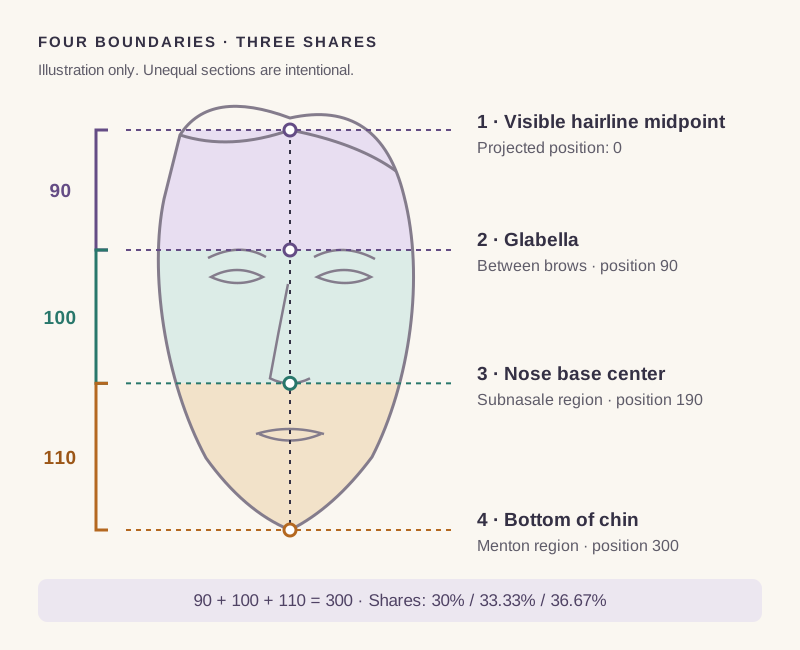
- Visible upper hairline midpoint
The central boundary where forehead skin meets the visible hairline, often called the trichion. Avoid the top of the hair, a fringe or a forehead mesh edge.
- Glabella between the eyebrows
The central brow region just above the root of the nose. Use this reference, rather than either eyebrow’s highest arch or the eyelid line.
- Nose base center
The central junction beneath the nose where the columella meets the upper lip, the subnasale region. The nose tip and nostril shadows are different points.
- Bottom of chin
The lowest visible soft-tissue chin boundary, the menton region. Do not extend the point to a beard edge or the neck.
The glabella-based thirds convention appears in the landmark discussion in Vertical Localization of the Malar Prominence (2015). On a photograph these placements remain manual approximations.
Make the boundaries easy to see
Face the camera at eye level with your head upright and a relaxed, closed mouth. Keep the hairline and chin in frame, move hair aside and use even light. Skip stretched images and reshaping filters. A more distant portrait avoids the close viewpoint of an arm’s-length selfie; see how selfie perspective changes proportions.
If the hairline is hidden, choose another image. Guessing it changes the denominator of every share.
Measure, inspect, keep a record
- Choose a photo or try the sample, then select Facial thirds.
- Select each point and place it on its visible boundary. Refine with arrow keys and Enter, or open exact coordinates.
- Check the order from hairline down to chin before reading the percentages. Reposition an uncertain point once to see its effect.
- Save the marked photo or download measurements with the endpoint definitions.
JPG, PNG and WebP files up to 20 MB are processed in this browser. The measurement JSON records geometry; the marked PNG includes your photo. See the privacy policy.
Each share uses the same hairline-to-chin span
The tool projects the four points onto the straight axis from your selected hairline to chin. It measures the gaps along that axis, rather than adding diagonal point-to-point lengths.
The unrounded shares total 100%. The result is unitless; it does not establish facial dimensions in millimeters.
| Section | Projected gap | Share of 300 |
|---|---|---|
| Upper: hairline → glabella | 90 | 30.00% |
| Middle: glabella → nose base | 100 | 33.33% |
| Lower: nose base → chin | 110 | 36.67% |
What do unequal facial thirds mean?
A 36.67% lower share means the nose-base-to-chin section occupies that proportion of your chosen span in this photo. It does not identify a skeletal cause, diagnose a condition or tell you to change a feature.
Equal thirds are a reference convention
Three equal sections would each be 33⅓%. That arithmetic is not a universal requirement. A 2015 study of 168 young Saudi adults found that its tested neoclassical canons did not fit the majority of participants. It used nasion and gnathion boundaries, so its numerical measurements cannot serve as norms for this glabella-based photo tool.
Keep the photograph in the conclusion
Write “these selected points give…” when recording a result. Head pitch, rotation, expression, perspective and point placement affect what you measure. Repeating the placement on the same photo can reveal selection sensitivity, but does not establish a clinical error margin. There are no validated target bands or population percentiles here.
Facial thirds, facial fifths and midface ratio
Facial thirds
Four boundaries create three projected height shares. The denominator is the complete selected hairline-to-chin axis.
Facial fifths
Use the Measurement menu above. Mark six boundaries in order: image-left face outline at eye level, outer eye corner, inner eye corner, opposite inner corner, opposite outer corner and image-right outline at eye level.
Five gaps are projected onto the outline-to-outline axis. They total 100% before rounding. The outer sections include the visible area beside each eye; this mode does not measure nose width. Equal fifths would be 20% each, without making 20% a required result.
Midface ratio
“Midface” has several online definitions. A middle-third height share differs from eye spacing divided by a vertical distance. Define both lines in the face proportion calculator before comparing ratios.
For eye-corner angles, use the canthal tilt calculator. It measures an angle relative to the photograph’s horizontal, rather than a share of height or width.
Before comparing your results
Can I use the eyebrow tops instead of the glabella?
That defines a different measurement. Keep the glabella reference for this tool and record any alternative explicitly. Eyebrow styling and arch height should not silently change the boundary.
Does a longer lower third mean a longer chin?
The lower third includes the entire nose-base-to-chin span, including the mouth region. This tool does not split it into lip and chin components or determine why a section appears longer.
Why do two calculators give different facial thirds?
Check their landmarks and denominator first. A forehead mesh edge is not necessarily the hairline; nasion, glabella and eyebrow peaks are different references. Different point placement, pose and projection methods also produce different numbers.
Will the percentages always add to exactly 100 on screen?
They add to 100% before rounding. Separately rounding each value to two decimals can produce 99.99% or 100.01%. The downloaded JSON retains the computed values.
Do facial thirds measure left-to-right symmetry?
No. They compare vertical sections. Use the face symmetry checker for selected left-to-right landmark comparisons, and read its separate method before comparing outputs.