
How Head Turn Changes a 2D Symmetry Score
A head turn can lower a photo-based symmetry score without changing the face itself. Our symmetric reference mesh scores 100.00 facing forward and 89.42 after a 12° turn under an orthographic projection. This experiment shows a limitation of our 2D formula; it does not supply a correction for your photograph.
In this guide
100.00 89.42
Straight ahead compared with 12° yaw
The viewing direction and projected point positions. The reference mesh was rotated as one rigid object; its shape was preserved.
What we tested
We supplied constructed coordinates to the same 2d-reflection-1.0 measurement function used by the face symmetry checker. That function compares 16 pairs across six regions, aligns the eye-corner-center line, reflects the selected points and divides each gap by eye-center spacing.
- Reference object
- Google’s static 468-vertex canonical face mesh.
- Controlled change
- Yaw, pitch, roll, one eyebrow edit or camera projection, as labeled below.
- Held constant
- The selected pair list, equal pair weights and scoring formula.
- Deliberately absent
- People, photographs, face detection, lighting changes and landmark-placement noise.
The mesh is a reference object, separate from the Face Landmarker’s estimated 478-landmark output. Google documents the canonical model and its topology in the Face Mesh documentation; the current Face Landmarker guide describes the detector’s outputs. Neither source validates this website’s symmetry index.

Yaw, pitch and roll describe different movements
- Yaw: turning to look sideways. Depth contributes to the projected horizontal positions.
- Pitch: looking up or down. In this constructed symmetric mesh, pitch alone preserves the measured left-right alignment.
- Roll: tilting the head toward a shoulder. The formula levels the eye line before comparing points.
Those last two findings concern exact coordinates in this setup. Real image capture, occlusion and detector estimates can still change a result when someone looks up, down or tilts their head.
Results from the reference model
These are separate deterministic runs, with no repeated sampling or error bars. “Mismatch” is the average reflected point gap as a percentage of eye-center spacing. The index is 100 minus that percentage, with a floor of zero.
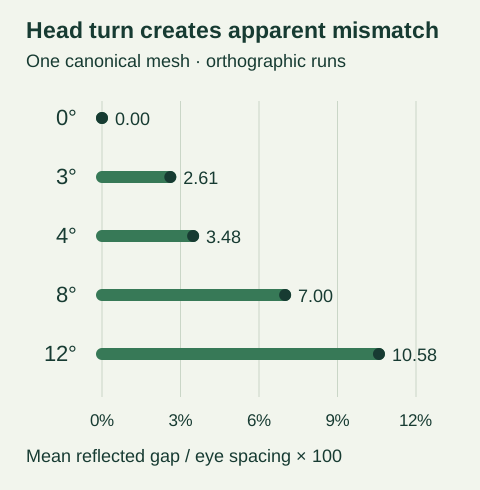
| Condition | Index | Mismatch |
|---|---|---|
| Straight reference | 100.00 | 0.00% |
| 3° yaw | 97.39 | 2.61% |
| 4° yaw | 96.52 | 3.48% |
| 8° yaw | 93.00 | 7.00% |
| 12° yaw | 89.42 | 10.58% |
| 22° pitch | 100.00 | 0.00% |
| 20° roll | 100.00 | 0.00% |
| Three points on one eyebrow raised | 98.12 | 1.88% |
| 12° yaw · pinhole | 85.46 | 14.54% |
The baseline, pitch and roll residuals are around 10−14 to 10−13 percent: floating-point effects, displayed as 0.00%. Full numeric values and regional readings are in the JSON.
Compare like with like
At the same 12° yaw, the orthographic run gives 89.42, while the specified pinhole run gives 85.46. That difference comes from changing the projection assumption, not changing the mesh’s shape.
One altered feature affects the average
The eyebrow edit raises three points by 10% of the original eye spacing. Three of 16 equally weighted pairs each contribute 10% mismatch: (3 × 10%) ÷ 16 = 1.875%, giving an ideal arithmetic index of 98.125. The script’s floating-point output falls just below that value and displays as 98.12.
All rows except the labeled pinhole case use orthographic projection. No visibility or occlusion simulation removes points that would be difficult to see in a real photograph.
Reproduce the calculation
The public files let you inspect the assumptions and recalculate every row without uploading a face or installing a detector model.
- Download four files into one folder. Save the reproduction script as
pose-sensitivity.mjs, plusmeasure.mjs,canonical-face.objand the published results aspose-sensitivity-reference.jsonfor comparison. Keep the model’s license with your copy. - Run the script with Node.js 22 or later. Open a terminal in that folder and run
node pose-sensitivity.mjs. No package installation is needed. The script prints the summary and writespose-sensitivity.jsonin that folder, replacing any previous output with that name. Your separately named reference file stays available for comparison. - Compare full numeric values. Check the nine conditions, overall mismatch and six regions in the new output against
pose-sensitivity-reference.json. Compare with a small floating-point tolerance, rather than requiring byte-identical numeric serialization across environments. - Change one assumption if you explore further. Keep your new output separately and label its rotation, projection and camera distance. A new run is a different constructed condition, not an estimate for a person.
Inspect the transform and camera assumptions
The script rotates the mesh about its canonical origin: pitch first, then yaw. For the pinhole case it multiplies the rotated x and y coordinates by D / (D − z), with the camera on positive z and D = 30 canonical units from the origin. Roll is then applied in the projected plane. These runs change one rotation at a time; they do not test combined rotations.
The x/y coordinates are mapped with the same scale, 20 working pixels per canonical unit, into a 1,000 × 1,000 image centered at (500, 500). Image y is inverted. The eye reference is the midpoint of corners 33/133 and 263/362. The eyebrow condition adds 0.1 times the original eye spacing to the y coordinate of vertices 70, 105 and 107.
After projection, measure.mjs converts normalized coordinates to image pixels, levels the eye line, reflects the selected pairs and averages their normalized Euclidean gaps. Read the complete pair list and equations.
See why depth matters in the orthographic yaw runs
For the exactly symmetric selected pairs in this mesh, a pair’s normalized gap simplifies to 2 × |z_pair − z_eyes| × |tan(θ)| / E. Here θ is the pure yaw angle, E is the original eye-center spacing, and z_pair and z_eyes are the original depth coordinates of the pair and the eye centers. The projected eye spacing contracts by cos(θ), while the depth offset contributes a horizontal shift proportional to sin(θ).
For these coordinates, E = 6.302291 canonical units and z_eyes = 3.465663. Averaging the 16 depth coefficients gives approximately 0.497929, so mean mismatch as a percentage is approximately 49.7929 × |tan(θ)|. At 12° this reproduces 10.5838% mismatch. This simplification applies to the pure orthographic yaw conditions and the selected symmetric coordinates; it does not apply to the pinhole or eyebrow-edit conditions, or provide an individual photo correction.
What the result changes in practice
Use a frontal, repeatable setup when comparing photo measurements. Keep camera height, distance, expression and lighting as consistent as practical, then inspect both landmark overlays before reading a score difference. The two-photo comparison tool helps you inspect each region using the same formula.
The automatic checker displays estimated head turn. Its current rules reject estimated yaw beyond ±12° or pitch beyond ±22°. These are implementation heuristics; passing them does not remove projection bias or establish that a photograph is accurate enough for a clinical measurement. The 12° row illustrates why a boundary is not an accuracy guarantee.
If a result changes, record what changed in the photograph. An altered index alone does not establish a physical change in the person. Explore why scores vary or separate camera distance from image cropping.
What this experiment cannot establish
- A per-degree adjustment for your face. The values belong to this mesh, pair list, eye reference and projection. Adding the illustrated loss back to your score would invent a correction.
- Accuracy of estimated head angles or landmarks. No detector was run, and there is no measured person or calibrated camera ground truth.
- A “normal” or attractive score. This record contains no participants, population distribution, attractiveness ratings or health outcomes.
- A validated 3D alternative. Extra depth coordinates, fitted midlines or different weights would define another method. They need independent testing against an appropriate reference.
Software sensitivity asks how an output responds to a specified input change. Clinical validation asks whether measurements serve a defined clinical purpose with acceptable error. This experiment addresses the first question.
Questions about head turn and the score
Can I add 10.58 points to correct a photo turned by 12°?
No. The 10.58-point difference is an output of this reference mesh under orthographic projection. A different face, viewing geometry, expression or detected landmark placement can produce a different result. Use a more comparable frontal photograph instead of applying this number.
Why does the turned mesh look uneven if its shape stays symmetric?
A 2D projection discards depth. Turning a 3D object changes how depth contributes to horizontal positions, so reflected image points can stop matching even when the object’s left-right geometry is preserved.
Does leveling the eye line fix a sideways turn?
It removes the in-plane eye-line angle used by this method. A sideways turn is a depth-related change in viewpoint, so rotating a flat image does not undo it.
Does the 100 pitch result mean an elevated camera is safe?
No. It shows preserved symmetry for the exact projected coordinates of this reference object. A real camera changes visibility and appearance, and the detector may estimate different points. Keep the camera at eye level for a more consistent comparison.
Was the experiment run on real photographs?
No. It projects the supplied 3D mesh mathematically and calls the production measurement function directly. The download contains no participant photos, personal measurements or detector outputs.
Sources and experiment record
The result table and plots come from our published experiment record and downloadable script. Google supplies the canonical OBJ mesh and describes its reference topology in the legacy Face Mesh documentation. The current Web Face Landmarker documentation describes the separate detector outputs.
Experiment originally published October 27, 2026; explanation, arithmetic and reproduction instructions reviewed November 2, 2026. No human study or independent clinical review is claimed. Editorial standards · Report a reproducibility issue.